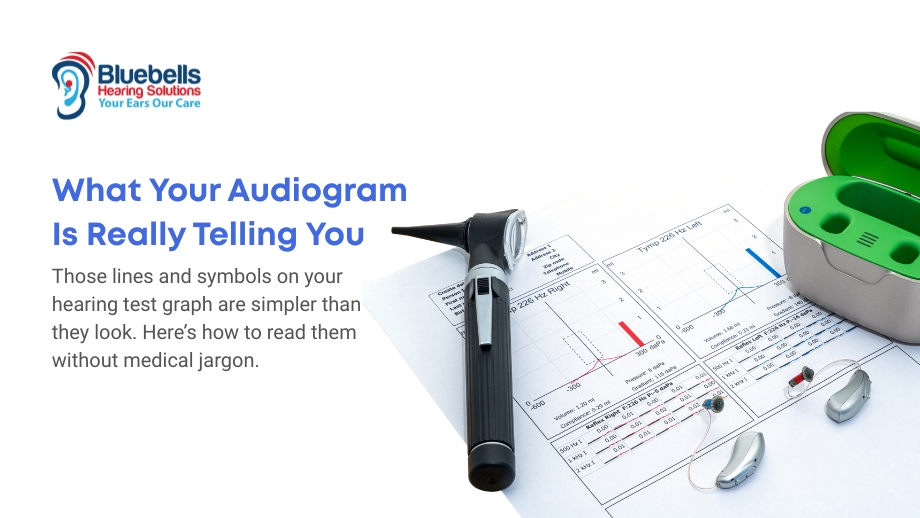
After a hearing test, your audiologist may show you a chart filled with lines, dots and numbers and call it an “audiogram.” At first glance it can look complicated, but once you understand the basics, it becomes a powerful picture of how your ears respond to different sounds.
An audiogram is essentially a map of your hearing sensitivity. The horizontal axis represents pitch, from low‑frequency sounds like drums and traffic on the left to higher‑frequency sounds like birds or many speech consonants on the right. The vertical axis shows loudness, measured in decibels, with softer sounds near the top and louder sounds lower down.
During the test, you listened to beeps through headphones and signalled when you heard them. Each response became a point on the graph. Typically, circles represent responses for one ear and crosses for the other. When these points are joined, they form lines that show the softest levels you could hear at each pitch.
If the marks hover near the top of the chart, it means you detect quiet sounds easily at those frequencies. When they dip lower, it indicates you need sounds to be louder before you can hear them. Your audiologist may compare your results with the typical speech area on the chart to explain why some voices or environments feel challenging.
Sometimes you will see two sets of lines: one for sounds delivered through headphones (air conduction) and another for sounds sent through a small device behind your ear (bone conduction). Comparing these helps identify whether the main challenge lies in the outer or middle ear, the inner ear, or both.
The most important part of your audiogram is not the numbers themselves but what they mean for daily life. A caring professional will translate the graph into real‑world examples: which sounds you may be missing, how this affects conversations and what options can help. Do not hesitate to ask questions; your audiogram belongs to you, and you deserve to understand it.
When you see that chart as a story rather than a puzzle, it becomes a useful tool for tracking changes and choosing the right support over time.